
World Mangrove Day
Mangroves are rare, amazing, and special ecosystems on the boundary between land and sea. They contribute to the wellbeing, food security, and protection of coastal communities worldwide. The International Day for the Conservation of the Mangrove Ecosystem, adopted by the General Conference of UNESCO in 2015 decided to celebrate World Mangrove Day on 26 July every year. Mangroves are salt-tolerant trees, also called halophytes, and are known as the ‘kidneys of our coast’.
The day aims to raise awareness on the importance of mangrove ecosystems as “a unique, special and vulnerable ecosystem“. In addition, it also aims to promote solutions for sustainable management, conservation, and uses. The day marks the critical importance of mangroves for food security, coastal protection, and its impact on climate change. UNESCO’s World Network of Biosphere Reserves lists 86 sites that include mangrove areas.
The World Heritage List includes the Sundarbans. It is the largest unbroken mangrove system in the world, shared between Bangladesh and India. They are shrubs or small trees in coastal saline or brackish water that grow above the average mean sea level of an intertidal zone.
1.1 Importance
Mangroves are the rainforests by the sea. Mangrove forests fringe large stretches of the subtropical and tropical coastlines of Asia, Africa, Oceania, and the Americas. They support rich biodiversity providing valuable nursery habitat for fish and crustaceans. In addition, they also act as a form of natural coastal defense against storm surges, tsunamis, rising sea levels, and erosion.https://en.unesco.org/commemorations/mangroveday
2.Significance to Ecosystem
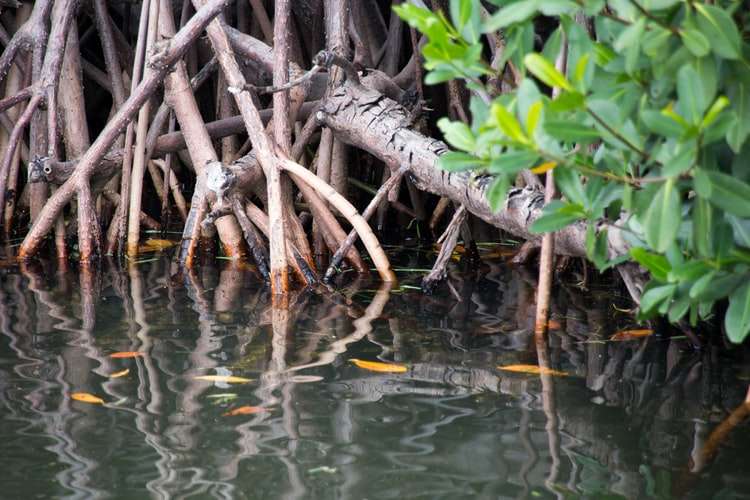
Mangroves are unique in many ways and are located at the edge of land and sea. The mangrove trees and shrubs form dense forests. Their special, intertwining roots helping them survive in the saline and brackish waters. Furthermore, they act as a form of natural coastal defense. They protect coastlines from storm surges, filter out pollutants, and are home to a wide variety of life. They are also adept at trapping excess sediment before it reaches the ocean.
Mangroves are an important habitat because of the role they play in nutrient cycling within our coastal environment. Many of the animals that live in mangroves feed on dead or decaying matter. Organisms higher in the food chain use the nutrients that return in other forms. Up to 70 percent of the seafood we eat is dependent on the mangrove environment for at least part of its lifecycle.
 They are warriors that play a valuable role in foreshore protection. Their extensive root systems assist in maintaining shoreline stability. During storms, they can reduce the rate of erosion. In addition, it reduces the impact of storm waves and surges by absorbing wave energy.
3.Threats
Mangroves are disappearing s faster than overall global forest losses. This consequently results in serious ecological and socio-economic impacts. Losses of mangroves also release large amounts of carbon dioxide into the atmosphere. Their biomass destruction results in the release of large carbon stocks held in their soils. This affects all of us on the planet as it contributes to global warming, further accelerating global climatic change.
The effects of human activities on mangroves have far exceeded those of natural events over the past few decades. Many mangrove habitats have been lost globally because of direct conversion to urban and industrial spaces, aquaculture ponds, tourist resorts, and agricultural land. Pollutants from agricultural and urban runoff, sewage, industrial waste, and oil spills, often end up in mangrove forests either directly or indirectly. Rapidly rising sea levels is the greatest threat of all. The effects on the shoreline and estuarine places are extremely devastating for natural environments as well as human society. Their disappearance is mainly due to clearing for shrimp aquaculture, and timber and fuelwood extraction.
4.Conservation
Appropriate management of mangrove ecosystems is required for their conservation and environmental benefits. Observing the importance of mangroves, Govt. of India set up a National Mangrove Committee in 1976. Different states in India are carrying out practices of conservation of mangrove cover with the active involvement of local communities. In States like Andhra Pradesh, Gujarat, Maharashtra, Odisha and West Bengal, have shown an increase in mangrove cover over the last few years due to plantation and regeneration.
4.1Management
Management and restoration of mangrove ecosystems is an achievable and cost-effective way to help ensure food security for many coastal communities. Mangroves can play an important role in reducing vulnerability to natural hazards and increasing resilience to climate change impacts.
4.2.Protection
Protection and restoration of the mangroves that we have already lost or degraded should have the highest priority because of its benefits to biodiversity. A world without mangroves would likely mean a world with fewer fishes, and more coastal damage. It will also result in public health consequences related to changes in pollutants, sediment, and carbon cycles.
Today there is a growing urgency to recognize the importance of conserving and restoring protective mangrove greenbelts. This will help to lessen the dangers of future catastrophes. However, as oceans warm and sea levels rise, the frequency and intensity of hurricanes and storm surge also rise accordingly.https://www.newsbharati.com/Encyc/2019/7/26/World-Mangroves-Day-Ocean.html
5.Projects and Methods for conservation
Mangrove Action Project (MAP) promotes the concept and practice of community-based ecological mangrove restoration (CBEMR) which is the most effective path towards conservation and recovery. This approach to restoration views the proposed plant and animal communities to be restored as part of a larger ecosystem. Accordingly,this is connected with other ecological communities that also have functions to be protected or restored.
CBEMR focuses on re-establishing the hydrology and topography, which will help in the natural regeneration process. Subsequently, it also engages local communities in the process and enabling them to regain the livelihoods that were ruined due to mangroves’ destruction.
Just as mangroves are the “roots of the sea,” this expanding network of partners and projects gives hope that it will continue to strengthen and spread its roots throughout the world.
For more articles on Environment please visit Environment : Aware Earth